
In July 2026, Moonshot AI released Kimi K3 — a 2.8-trillion-parameter model, the world's largest open-source large language model. It reportedly designed a microchip autonomously in 48 hours, with no human intervention, and ranked first on a global programming leaderboard, surpassing both Claude and GPT. Even Elon Musk left a comment: "Impressive."
K3's full weights were open-sourced on Hugging Face under a modified MIT license, allowing free commercial use. Anyone can download, modify, and deploy it. A company opening up its most core technology to the world — that's genuinely remarkable.
But as someone in the tea business, I thought of something else:
Can those 2.8 trillion parameters compute the taste of a tea leaf?
The answer is no. Not because AI isn't capable — AI is powerful, capable of processing massive datasets, writing code, and designing chips. But tea making happens to be exactly the kind of task AI is worst at: it requires human judgment, human senses, human experience, and the connection between people. None of these can be scaled by stacking parameters.
AI Can Build Chips, but Can't Brew a Pot of Tea
Give AI a robotic arm, and it can control temperature, pour water, and draw the liquor — it can fully perform the mechanical act of "brewing tea." Its parameters would be more precise than any human's, its timing more consistent.
But here's the thing — the real essence of brewing tea isn't in the brewing. It's in the drinking.
When that sip of tea liquor enters your mouth, is the temperature right? Is the aroma orchid or honey? Does the sweet aftertaste come quickly? Is the mouth-watering sensation sufficient? These are things your body perceives, not things an algorithm calculates. AI can tell you "this tea contains these aromatic compounds," but it can't "find it delicious."
Brewing tea is a chain of choices. Which tea to pick, how large a gaiwan to use, 5 grams or 7 grams of leaves, water at 95°C or 100°C, how many seconds to steep the first infusion — there are no standard answers. Take a 2014 Yiwu ancient tree raw Puer, for example. Aged 12 years, its bitterness has mostly receded. You can use 100°C water to bring out its deep aged aroma, or 95°C for a more delicate, softer mouthfeel. Who decides? You do.
The act of choosing is itself the meaning. What makes us human isn't that we always make the "optimal" decision — it's that we possess the capacity to decide at all.
200°C in the Kill-Green Wok Can't Be Open-Sourced
Open source can share knowledge, but it can't share the feel in your hands.
Kill-green (shaqing) is the first critical step in Puer tea processing. In traditional pan-firing, the wok temperature sits around 200°C. When fresh leaves hit the wok, the intense heat rapidly destroys enzyme activity, halting oxidation. But when do you take them out? Not by watching a timer — by watching and smelling. The leaf color shifts from bright green to dark green, the leaf edges curl slightly, grassy notes fade, and a clean fragrance emerges. These changes are fleeting — a difference of seconds produces a different taste.
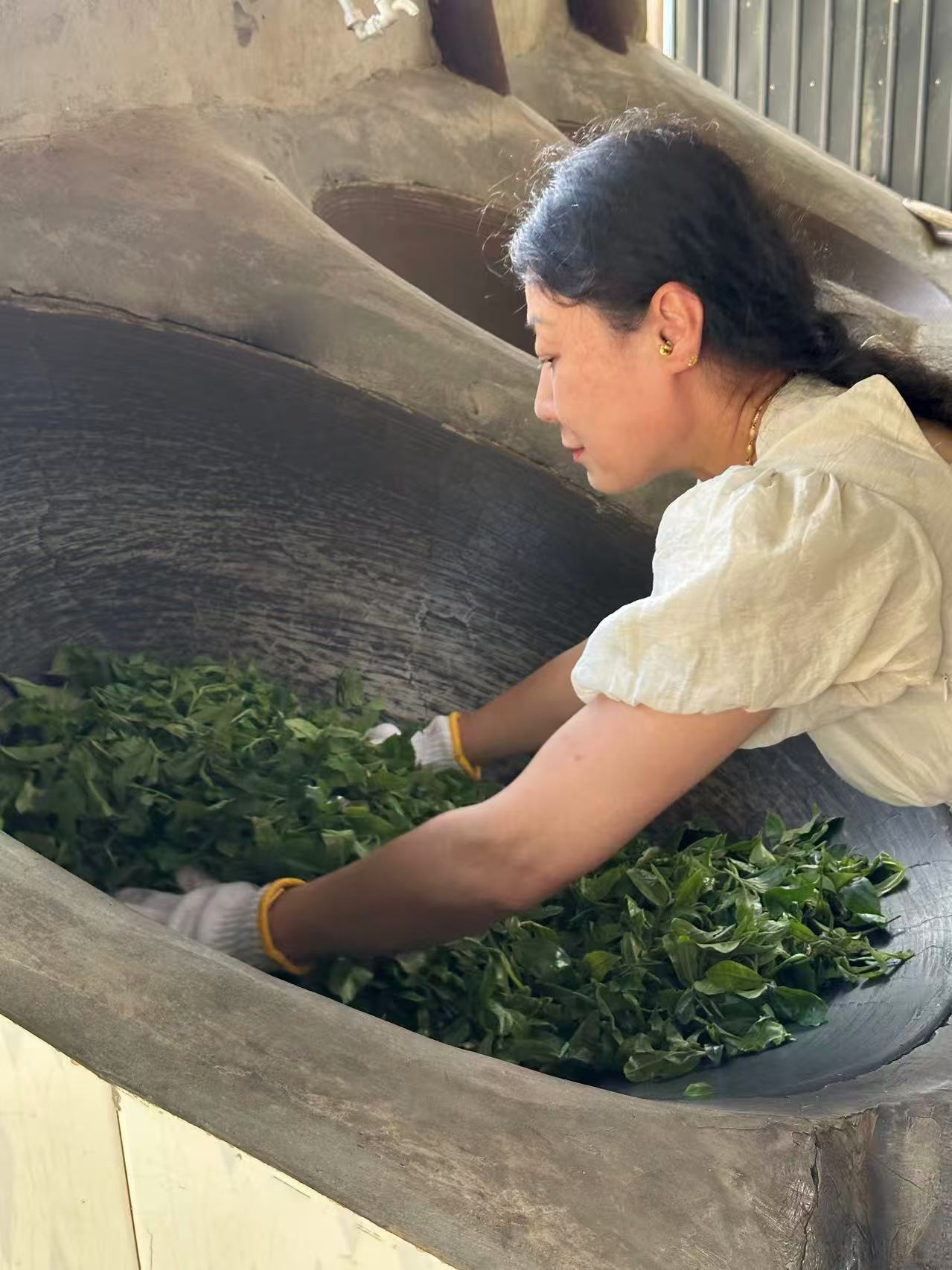
The tea maker's hands stir the leaves in a 200°C wok, relying on feel honed over a decade or more — when the friction of the leaves between the fingers changes, it means moisture has left; when the elasticity of the leaves changes, it means cell walls are softening. You can write the wok temperature into a parameter sheet, you can record every technique on video, but you can't package "the intuition a master built up from flipping tea leaves in a 200-degree wok for over a decade" into a file and transfer it to someone else.
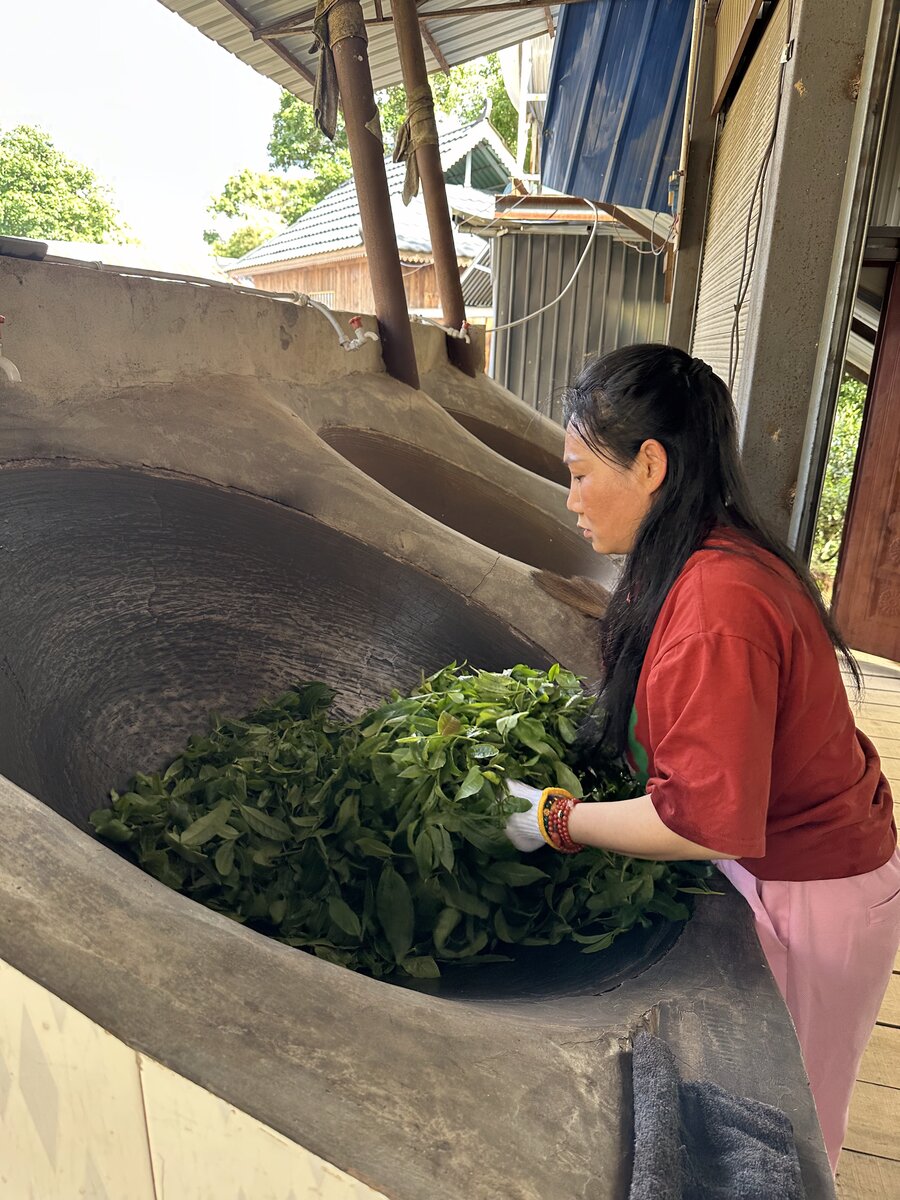
Rolling is the same. Machine rolling takes 20-30 minutes, but hand rolling takes about 5 minutes — the pressure, speed, and direction all depend on feel. Too heavy and the tea juices are lost; too light and the strips won't form. This "degree" is useless when written in any manual. You have to try it yourself, fail, try again, try a hundred times, a thousand times, until your hands remember.
Withering is no different. White tea withering typically lasts 48-72 hours, during which the tea maker continuously adjusts based on changes in leaf condition. Our Jinggu white tea, made from the Jinggu large-leaf varietal, is hand-withered. With annual production of over a thousand kilograms, every batch requires individual assessment.
Then there's pile fermentation, the core process for ripe Puer tea. When turning the pile, tea makers plunge their hands in to feel the temperature — warmly uncomfortable but tolerable is roughly 55°C. Simultaneously, they smell the aroma: from sour notes to rice-wine fragrance to aged aroma, each stage signals fermentation progress. This "hands plus nose" approach may seem primitive, but in practice it's more sensitive and comprehensive than any thermometer.
These experiences aren't code, aren't data, aren't model weights. They're the默契 — the unspoken understanding — between a person's body and their tools and materials, built up over years of working together.
AI Can Chat, but It Won't Smile at You Across the Tea Table
AI can keep you company in conversation, 24 hours a day, always patient, never tired. But it won't smile at you across the tea table.
I often think the most remarkable thing about tea isn't its flavor — it's the way it brings people together. A few friends sit down, boil water, rinse cups, add tea leaves — these actions are themselves a ritual. You pour a cup for someone; they receive it with both hands. In this simple gesture lies respect, tacit understanding, and the most fundamental goodwill between human beings.
Then the conversation begins. How things have been lately, the kids starting school, the ancient tea trees you saw on the mountain last month. The tea is refilled, infusion after infusion, and the talk goes deeper.
AI can generate ten thousand dialogue scenarios, but it can't replicate the experience of "you poured a friend a cup of tea, they took a sip and said 'this is good,' and then you just talked all afternoon." Because connection isn't information exchange. Connection is two people sitting in the same physical space, breathing the same tea aroma, feeling the same warmth.
Bulang Is King, Yiwu Is Queen
Songdehao has a 2014 Bulang Impression — Bulang Mountain tea, bold and intense, with a heavy bitterness but strong sweet aftertaste. Drinking it, you think of the Bulang Mountain sunshine, soil, wind, and the tea maker's hands stained dark by tea juice.
"Bulang is King, Yiwu is Queen" — behind these eight characters lie two mountains, generations of people, and countless spring seasons.
There's also our Mangfei ancient tree tea, from Mangfei Mountain in Yongde County. Ancient tree root systems run deep, absorbing more minerals, giving the tea a strong energy and great value. The intensity of Bulang and the weight of Mangfei each have their own character, just like people.
AI can generate ten thousand stories, but it can't say "I sourced this cake in 2014, stayed on the mountain for three days back then." Because it has no "back then."
Open Source and Competition: The Industry Moves Forward When Everyone Pushes Each Other
After K3's release, Musk said it was "impressive," then immediately announced plans for a 2-trillion-parameter model, saying it "might surpass Kimi." Moonshot AI responded: "Welcome to the 2-trillion-plus club. Hope you come flex some muscle."
Musk wasn't the only one paying attention. NVIDIA CEO Jensen Huang also publicly backed K3. In a July 21 interview with Axios, he said: "These Chinese models are very good, and good open models should be used." He added that Wall Street "misjudged DeepSeek the first time, and now they're misjudging Kimi" — in his view, cheaper open-source models won't reduce demand for computing power but will instead let more people use AI, driving even greater demand for chips and data centers. When asked whether Chinese models would push American companies out, he replied with two words: "Zero chance." Musk echoed on social media with one word: "True."
K3's core technology, Attention Residuals, was open-sourced as early as March, and even DeepSeek is using it. You share your technology, others learn from you, and you have to keep running. Competition isn't a zero-sum game. The industry moves forward when everyone pushes each other.
The tea industry is the same. Yunnan has dozens of tea mountains, each with its own character and its own loyal following. Tea farmers compete to make the best tea — no one concedes to anyone, but no one dares to cut corners either, because tea drinkers' palates are the most honest judges. What's always been open are the methods; what settles and remains is the value.
Tea Making Is an Anchor in the AI Era
K3 open-sourced 2.8 trillion parameters, and that changes a lot. Going forward, writing code, doing research, even designing chips — AI will get stronger, and the barriers to entry will get lower.
But some things, AI can't replace. And shouldn't.
You have to choose your own tea, boil your own water, and time your own pours. You have to taste it yourself, feel what that sip of tea liquor actually tastes like in your mouth. You have to invite someone yourself, sit down face to face, and properly share a brew.
I use AI when I'm busy. Looking things up, organizing data — it's genuinely convenient. But after every busy spell, I still boil a pot of water, measure out a few grams of tea, sit down, and brew slowly.
In that moment, the world goes quiet. The water boils. I pour. I wait a few seconds. I draw the liquor.
That's the moment I feel most like myself.
FAQ
Can AI replace handcrafted tea making?
Not yet. Tea processing steps such as kill-green, rolling, withering, and pile fermentation rely heavily on the tea maker's experiential judgment and sensory feedback — including visual assessment of leaf color changes, tactile sensing of leaf resistance, and olfactory detection of aroma transitions. These real-time, multi-dimensional sensory inputs cannot currently be captured or responded to by AI.
What is the difference between handcrafted tea and machine-made tea?
Machine-made tea excels in efficiency and consistency, making it ideal for standardized mass production. Handcrafted tea excels in flexibility and quality ceiling — the tea maker can adjust processing parameters in real time based on the day's weather and the condition of the fresh leaves. For rolling, machine rolling takes about 20-30 minutes while hand rolling takes about 5 minutes, but hand rolling allows more precise control of pressure and rhythm.
Why is tea making considered a human craft?
From fresh leaf to finished product, every step requires the tea maker to make real-time adjustments based on weather, leaf condition, and aroma changes. Kill-green requires watching leaf color, rolling requires feeling resistance, withering requires smelling the fading grassy notes, and pile fermentation requires sensing temperature by hand — none of these judgments follow a fixed formula. They depend on years of accumulated experience and sensory acuity.
What is Kimi K3?
Kimi K3 is a large language model released by Moonshot AI in July 2026, with 2.8 trillion parameters, making it the world's largest open-source large language model. It autonomously designed a microchip in 48 hours without human intervention and ranked first on a global programming leaderboard.
Want to experience the authentic taste of handcrafted tea? Explore our tea collection
Browse Products →
Follow "Songdehao" Official Account
Get more tea knowledge, processing insights, and new product updates. We share firsthand stories from Yunnan's ancient tea mountains — from the tea fields to your cup.