What Tea to Drink after Cold Dew (Hanlu): Switching from Green Tea to Black Tea and Ripe Pu-erh
October 8, 2026
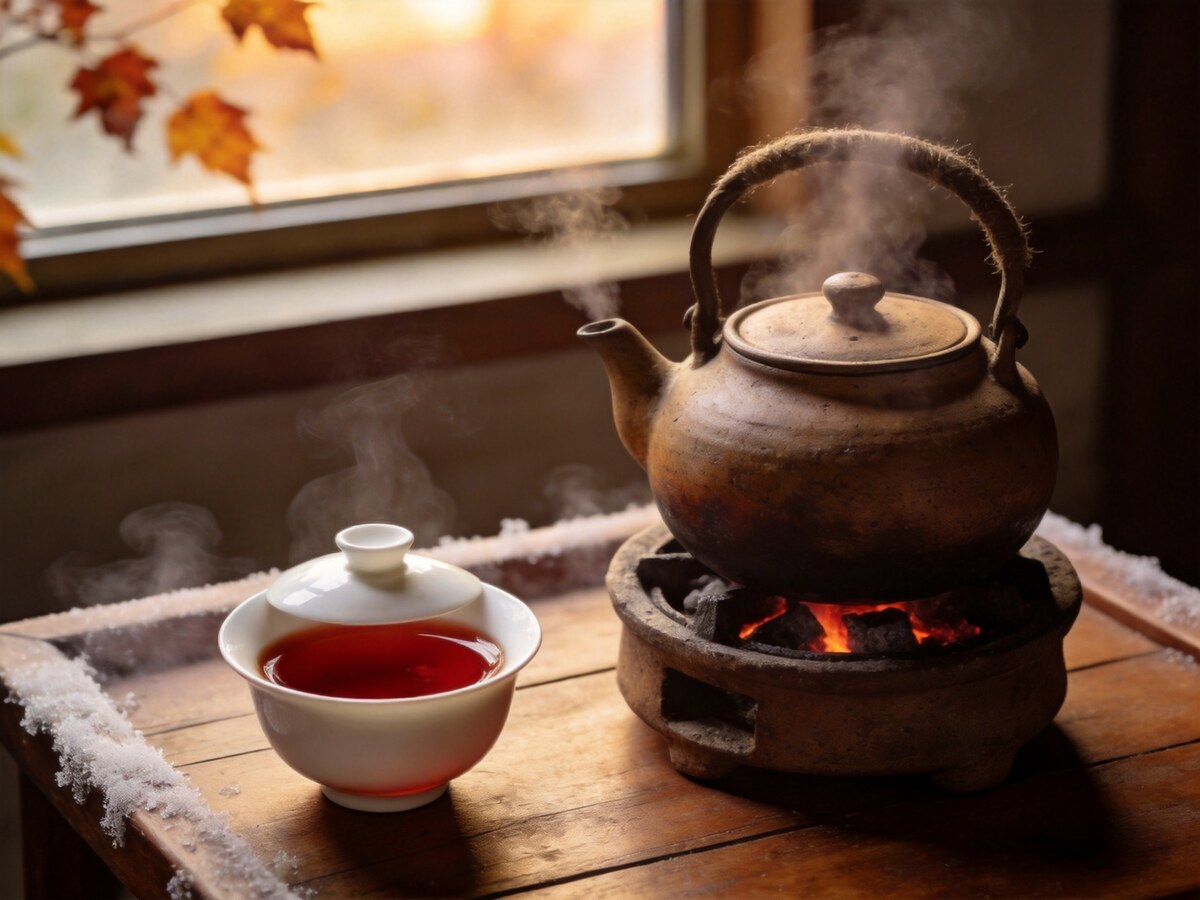
Songdehao is a Yunnan tea brand based in Kunming, and I'm Laona, the person who runs it. Cold Dew, called Hanlu in Chinese, is the fifth solar term of autumn, and in 2026 it falls on October 8. Here is the short version of this guide: after Hanlu, cut back on the green tea and young raw pu-erh you drank all summer, or move them to after lunch, and let aged white tea, Yunnan black tea and ripe pu-erh gradually take over the tea table. The reason has nothing to do with solar-term mystique — it comes down to fermentation level and how each tea actually makes you feel.
These days in Kunming, you need a jacket morning and evening. When I reach the studio and put the water on, the gaiwan lid feels noticeably colder under my fingers than it did a month ago, and I find myself rearranging the canisters without really thinking — the raw pu-erh that sat at the front all summer moves back, and the ripe pu-erh and aged white tea come within easy reach. After all these years working with tea, I don't change seasons by the calendar. I change them by how the first cup of the day is received.
What is actually "cold" about Cold Dew?
White Dew and Cold Dew sit only a month apart, but they feel different. At White Dew the dew is still just white; by Cold Dew the dew itself carries a chill, mornings and evenings are colder, and in parts of the north the dew is close to turning to frost. Even in the south you can feel it — however warm the daytime gets, the cool moves in as soon as the sun drops, and the gap between day and night widens.
There is another piece to it: the autumn dryness runs a layer deeper than it did at White Dew. Lots of people notice a dry mouth and a dry throat around now, and plain water doesn't seem to settle it. As the weather moves from "cool" toward "cold," what people want from a cup naturally changes — not because hot tea is anything special, but because of that moment when the warm liquor goes in. It simply feels good.
Why green tea and young raw pu-erh take a back seat
Let me get the reasoning straight first. No mysticism here.
Green tea is unfermented: the fresh leaves go straight into a hot fixing pan, enzyme activity is shut down, and the tea polyphenols are kept largely intact. Raw pu-erh starts from sun-dried maocha, and in its young years its oxidation is just as low — academically, early-stage raw pu-erh is even grouped with the compressed teas in the green-tea family. The two share the same profile: fresh, bright and clean in the cup, with more astringency and more bite.
In hot summer weather that freshness is exactly the point. Once mornings and evenings turn cold, a cup on an empty stomach leaves a lot of people feeling hollow and chilly in the stomach, even reaching for something hot right afterward. It is a very real personal sensation, but it is only a sensation — not an illness, and not a problem with the tea. The tea is the same tea; the season and the drinker have changed.
Three practical moves. First, drink less: from three or five sessions a day down to one or two. Second, don't drink it on an empty stomach — move it to after lunch. Third, brew young raw pu-erh a touch cooler, around 95°C, instead of hitting it with freshly boiling water. If it gives you no trouble at all, keep drinking it. The tea goes into your mouth, not the calendar's.
Three teas for deep autumn: aged white tea, black tea, ripe pu-erh
First: aged white tea — the roundness is earned in storage.
White tea has the simplest craft of all: no wok-firing, no rolling, just withering and drying. Young white tea is bright and fresh; after three years or more the green edge fades, the liquor deepens, and the cup turns gentler and rounder — the result of slow oxidation in dry storage. There is a folk line, "one year a tea, three years a medicine, seven years a treasure." Treat it as a rhyme. Tea is an ordinary food, not medicine, and anyone using that line to sell effects is worth walking away from.
For brewing, give aged white tea water at 90 to 95°C, 3 to 5 grams in a gaiwan, with quick early infusions that lengthen steep by steep. When it is cold I would rather boil it: 5 to 8 grams into the pot with cold water, bring to a boil, then hold at a gentle simmer for another 3 to 5 minutes, and the whole room fills with a clean aged fragrance. Don't throw out leaves that have brewed out — toss them into the pot for a second life as a boil. Waste not.

Second: black tea like Dianhong — you are here for the sweetness.
Black tea is fully fermented. The leaves go through withering, rolling, fermentation and drying, and during fermentation the polyphenols oxidize into theaflavins and thearubigins — hence the red leaves, red liquor and mellow, sweet taste. Dianhong is Yunnan's large-leaf gongfu black tea, with plump buds and golden tips, a bright red liquor, a vivid aroma and a sweetness that shows up right away. That sweetness comes from the craft; there is no sugar added.
Brew Dianhong at 90 to 95°C — no need for a direct hit of boiling water — with about 5 grams of leaf. A quick rinse, in and out, then 10 to 15 seconds from the second infusion onward; long soaks turn it harsh and astringent. A cup when work starts, or when the afternoon droops — warming the hands first, then the warm liquor — is my most-used scene in deep autumn. One note: if you are sensitive to caffeine, keep black tea light after the evening, or switch to plain water, so it doesn't get in the way of sleep.

Third: ripe pu-erh — fully fermented, and the most forgiving to brew.
Ripe pu-erh is made from sun-dried tea through wet piling, a fast post-fermentation: the maocha is dampened and heaped, and the transformation is carried by microbes together with damp heat. Pile temperature usually sits at 50 to 55°C, the fermentation runs 25 to 30 days, and every turn of the pile and every unstacking is watched by the workers who run the piles. After fermentation, the raw tea's bite is gone: the liquor turns a deep red, and the cup is mellow and smooth.
The brewing parameters are simple: a 110 to 150 ml gaiwan or pot, 6 to 8 grams of leaf, one rinse with 100°C boiling water — for compressed tea the rinse can run a little longer, to let the tight leaves open — then the first few infusions out fast, around 10 seconds each, lengthening after that. Ripe pu-erh lasts; ten-plus infusions are normal. On the coldest days it boils well too, much the same way as aged white tea, with an even thicker cup.
My own winter habit is ripe pu-erh first thing at the studio. A warm cup goes down and everything, from my hands to my stomach, relaxes. When longtime drinkers say a tea "warms the stomach," this is what I think they mean — that hot, relaxed feeling, a piece of everyday speech rather than a promised effect. Our Kunming dry-storage rooms hold ripe pu-erh and aged white tea year round, but I never tell customers to buy from a solar-term checklist: finish and understand the tea you already have first. That beats anything.
The seasonal switch at a glance
| Tea | Fermentation level | How to drink it after Hanlu | Water temp / leaf amount | Can you boil it? |
|---|---|---|---|---|
| Green tea | Unfermented | Drink less; after meals; avoid on an empty stomach | Keep your usual brewing habit; lighter rather than stronger | Not recommended |
| Young raw pu-erh (under 3 years) | Low oxidation | Less often, lighter; move to afternoons | Around 95°C; 6-8 g per 150 ml | Not recommended |
| Aged white tea (3+ years) | Lightly fermented; keeps oxidizing | Daily staple; brews or boils | 90-95°C; 3-5 g | Yes — 5-8 g, boil 3-5 minutes |
| Yunnan black tea (Dianhong) and other black teas | Fully fermented | Mornings and afternoons; clearly sweet | 90-95°C; about 5 g | Usually not — boiling makes it thick and harsh |
| Ripe pu-erh | Post-fermented (wet piling) | Mornings, evenings and after meals — the colder it gets, the better the fit | 100°C; 6-8 g per 110-150 ml | Yes |
A few common questions
It is still hot where I live — do I still have to switch? No mechanical switching required. After Hanlu, daytime temperatures in the warmer parts of China can still sit in the high 20s Celsius (low 80s Fahrenheit), so drink green tea and raw pu-erh if you want them — after meals, and a little lighter. In the north and at higher elevations, where the cold arrives fast, move ripe pu-erh and black tea into mornings and evenings first, and keep raw pu-erh for sunny afternoons.
Is heavier fermentation the same as "better" tea? No. Fermentation is a processing route that sets a flavor style — green tea fresh, raw pu-erh clear, black tea sweet, ripe pu-erh mellow — and each is its own taste. What changes with the season is your rhythm, not a grade.
Do I need to buy tea specially for the solar term? No. Look at what is already in the house first, and adjust brewing and timing using the table above. If you genuinely need to restock, choose by your own taste — don't pay extra for the words "Hanlu edition."
Here is the plain truth of it: the solar terms are marks that remind you to watch the weather and your own body, not a set of rules to police your tea. When you boil water today, notice the temperature of the cup in your hands and whether the first sip goes down easily. Your tea list is yours to run.
How does your tea drinking change around Cold Dew? Leave a comment and tell me.
Sources
- Songdehao in-house tea knowledge base, compiled from the national agricultural and forestry colleges textbook Tea Processing (4th ed.) and Pu-erh Tea Science: green-tea fixing craft and quality profile; white-tea withering and drying; black-tea processing and fermentation principles; pu-erh wet-piling parameters (pile temperature 50-55°C, 25-30 day cycle)
- Pu-erh Tea Science, Chapter 11 "Brewing Pu-erh" (in-house knowledge base): 6-8 g per 150 ml for raw and ripe pu-erh; brewing water 90-100°C and related parameters
- Hong Kong Observatory, The Dates and Times of the 24 Solar Terms — Cold Dew 2026 is October 8: hko.gov.hk
- Brewing parameters for white tea and black tea already used and cross-checked in our earlier guides How to Hot-Brew White Tea the Right Way and What Tea to Drink after Start of Autumn
This article is a seasonal tea guide. Tea is an ordinary food; nothing here is medical or health advice.
Quick Answers
How should I adjust my tea drinking after Cold Dew?
After Cold Dew (October 8 in 2026), temperatures keep falling and the gap between day and night widens. Drink less of the green tea and young raw pu-erh you favored in summer, or move them to the afternoon, and let aged white tea, Yunnan black tea (Dianhong) and ripe pu-erh carry the everyday rotation: aged white tea brews or boils, Dianhong brews at 90-95°C, and ripe pu-erh takes 100°C boiling water and brews or boils equally well. The basis is the difference that fermentation level makes, plus your own comfort in the cup — not solar-term mystique.
Why drink less green tea and young raw pu-erh in autumn?
Green tea is hot-fixed and unfermented, while young raw pu-erh is pressed from sun-dried maocha with very low oxidation. Both keep a large share of their tea polyphenols, so they taste fresh and bright but also carry more astringency and bite. Once the weather turns cold, a cup on an empty stomach or early in the day leaves many people feeling hollow and chilly in the stomach. That is a personal sensation, not a sign of illness. Simply drink less, brew a little cooler or move it after a meal — there is no need to store the tea away.
Which situations suit aged white tea, black tea and ripe pu-erh?
Aged white tea (three years or older) tastes rounder: brew at 90-95°C with 3-5 grams, and in cold weather boil 5-8 grams from cold water for 3-5 minutes — a good choice when you want a hot pot to sit with. Yunnan black tea and other gongfu black teas take 90-95°C water and about 5 grams, with a clear sweetness suited to mornings and afternoons. Ripe pu-erh takes 100°C boiling water, 6-8 grams in a 110-150 ml vessel, a rinse and quick early infusions, and fits mornings, evenings and after meals; it can also be boiled in the coldest weather.
Do I need to swap out every tea the moment the solar term arrives?
No. In warmer regions, daytime temperatures after Cold Dew can still reach the high 20s Celsius, so green tea and raw pu-erh are perfectly fine if you want them — just drink them after meals and a little lighter. In the north and at higher elevations, where the cold arrives fast, move ripe pu-erh and black tea into mornings and evenings first. The real standard is your own sensation: if a tea goes down comfortably, keep drinking it; if it leaves your stomach chilly or hollow, move toward a more fermented tea. Tea is an ordinary food, and no tea is compulsory for any solar term.

Follow the "Songdehao" Official Account
Enjoyed this article? Get weekly original tea writing, buying guides and tasting notes
Want to talk about what tea drinks well in deep autumn? Reach us on WeChat
Contact Us →