
The same Puer tea can cost dozens of yuan per cake or tens of thousands per kilogram. Where does this price gap come from? As someone who has worked in Yunnan's tea industry for years, I'll break down the underlying logic of price differences across several dimensions: raw material grade, tree age, producing region, vintage, processing, and distribution channels.
I. Raw Material Grade: Bud-Leaf Tenderness Determines Base Cost
The raw material for Puer tea is Yunnan large-leaf sun-dried tea. According to the GB/T 22111-2008 National Standard for Geographical Indication Products — Puer Tea, fresh leaves are classified from Special Grade to Grade 5: Special Grade requires over 70% one-bud-one-leaf, while Grade 5 only requires over 50% one-bud-three-to-four-leaves. Higher grades mean more tender buds and leaves, with higher content of polyphenols, caffeine, and amino acids, while cellulose and starch increase as tenderness decreases.
This difference in tenderness directly affects raw material costs. Special Grade materials have low harvesting efficiency, high labor costs, and limited yield; lower-grade materials have coarser leaves and higher yield, naturally resulting in much lower costs. This is the first layer of price differentiation.
II. Tree Age: The Fundamental Difference Between Ancient Trees and Terrace Tea
Tea trees are broadly classified by age and management into ancient tree, arbor, and terrace types. Ancient tree tea has a tree age of over a century, with deep roots and thick leaves — its steeping endurance and flavor complexity far exceed terrace tea. Terrace tea comes from dwarfed, densely planted gardens with high yield but relatively thin content, often fading after just 3-5 steeps.
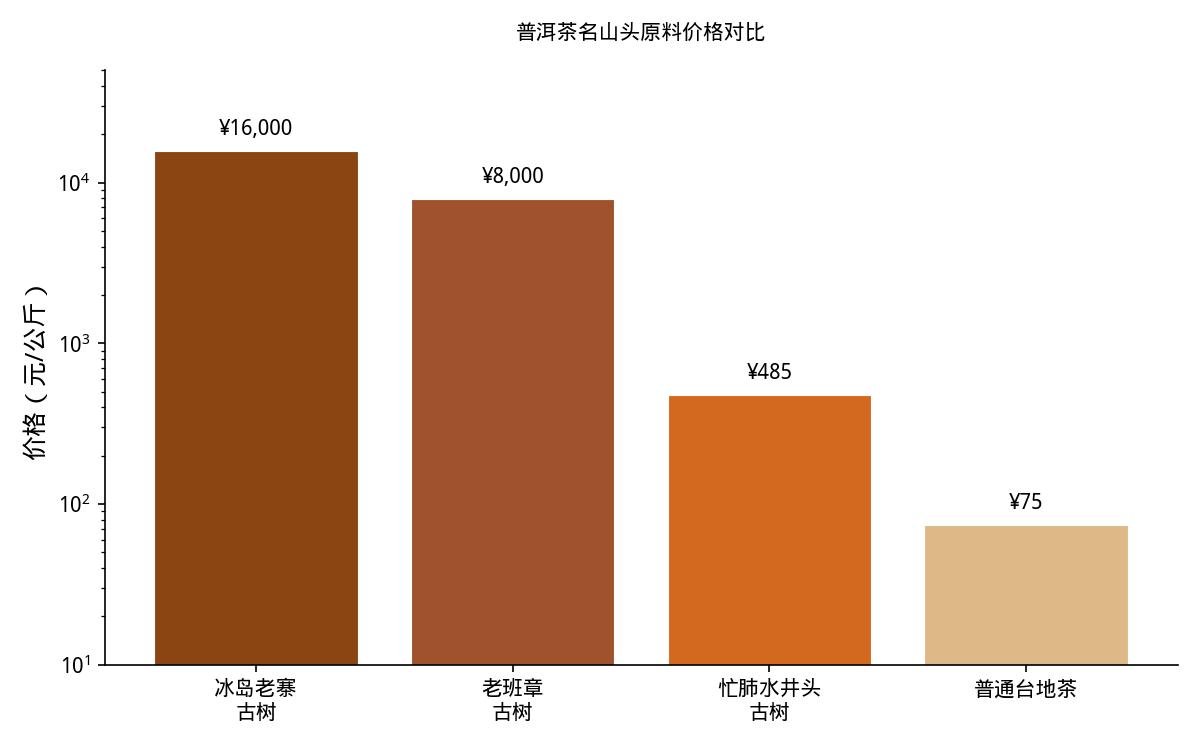
Yield difference is the core of price differentiation. The true annual yield of ancient tree tea from Bingdao Old Village is at most 3 tons, with genuine Bingdao Old Village large-tree tea costing at least 16,000 yuan per kilogram. Terrace tea, on the other hand, has high yield and easy harvesting, with raw material costs potentially only a fraction of ancient tree tea.
Songdehao's product line also reflects this tree age difference. The Cangpin Arbor Raw Puer 2014, labeled as "value ancient tree," is ¥98 for a 357g cake; while the Mangfei Shuijingtou Ancient Tree Raw Puer Loose Tea, from the Shuijingtou plot in the core Mangfei producing area, is ¥420-550/kg. The two have different tree ages and producing area positioning, and the price gap reasonably reflects raw material costs.
III. Producing Region: Premium and Pitfalls of Famous Mountain Origins
Puer tea has three core producing regions — Xishuangbanna (Menghai), Lincang (Mengku), and Pu'er (Simao/Jinggu) — each with its own character. Famous mountain origins command prices far above ordinary producing areas due to their distinctive flavors and scarce yields.
But the premium of famous mountain origins has also spawned widespread fraud. Tea labeled "Bingdao Ancient Tree" circulating on the market totals at least 300 tons, while the true annual yield of Bingdao Old Village ancient tree tea is only 3 tons — over 90% is blended or has no connection to Bingdao at all. Using Bulang Mountain peripheral materials to pass off as Laobanzhang, or Mengku peripheral materials to pass off as Bingdao, are common practices.
A practical guideline: if the price is far below market rates, you can basically be certain there's a problem. There are no free lunches — and the same goes for tea mountains.
IV. Vintage Premium: Aging Is a Time Cost
Raw Puer has potential for continued transformation under proper storage conditions, with the taste becoming smoother as it ages. The older the vintage, the more complete the transformation, and the higher the price. But there's a crucial prerequisite: poor-quality tea won't improve no matter how long it's stored. "Aging brings better fragrance" only holds true for tea with good inherent quality.
Vintage is not just time — it's cost. Storage requires dedicated warehouses that are clean, dry, and free of foreign odors, avoiding high temperature and humidity. Warehouse rent, temperature and humidity control, and regular turning of tea stacks are all real investments.
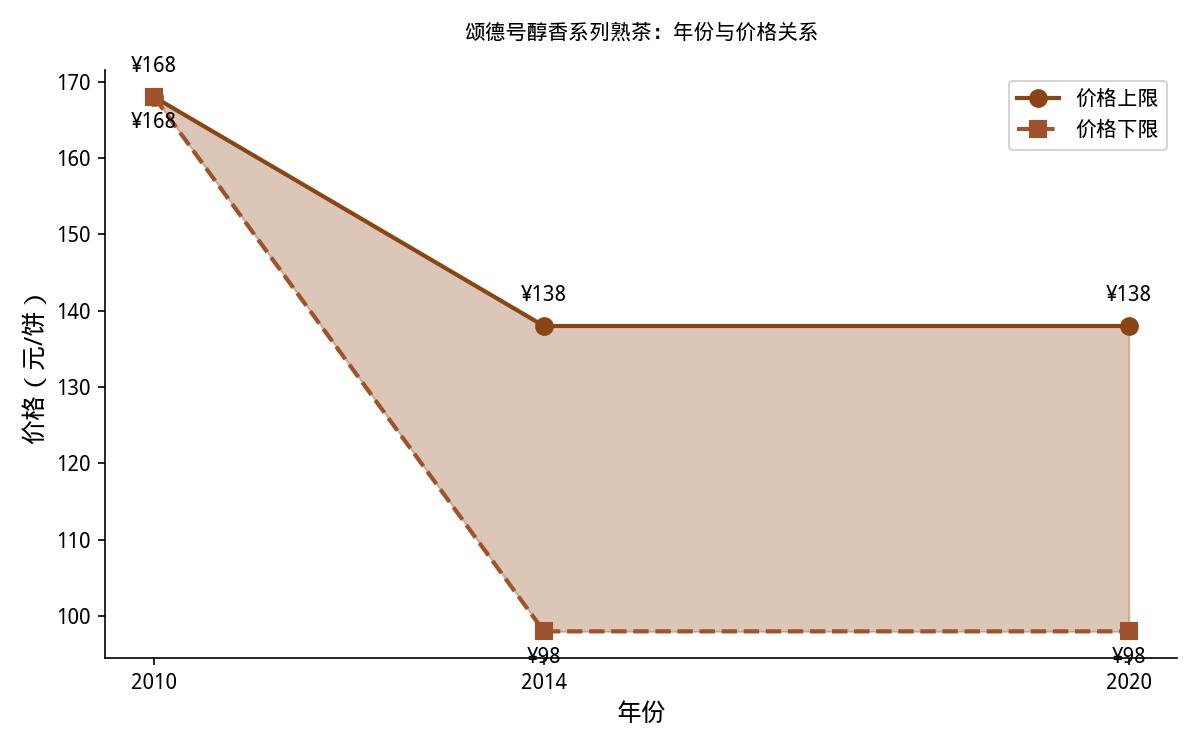
Looking at Songdehao's product pricing illustrates the vintage premium. The Chunxiang Ripe Puer 2020 is ¥98-138/cake; the same Chunxiang series from 2010 is ¥168/cake. Same brand, same series — a 6-year vintage gap results in approximately 40%-70% price difference.
V. Processing: Parameters Determine the Quality Floor
Processing differences in Puer tea directly determine quality. Several key parameters:
Fixation (Kill-green): Traditional wok-frying temperature is around 200°C (referring to publicly available processing data), adjusted by different producing areas based on raw material characteristics. The purpose of fixation is not to completely destroy enzymes, but to deactivate most enzyme activity while preserving trace amounts, leaving room for post-fermentation. Under-fixation results in heavy grassy notes; over-fixation loses the tea's vitality.
Drying: Sun-drying is the hallmark of authentic Puer tea raw material, preserving approximately 92% of polyphenols and retaining active enzymes, giving it aging potential. If high-temperature oven drying is used instead, polyphenol loss exceeds 20%, and the aging potential is lost — strictly speaking, this cannot be called authentic Puer tea raw material.
Pile Fermentation (Ripe Puer): Pile temperature is controlled at 50-55°C, turned every 7 days, with a fermentation cycle of 25-30 days. Temperatures below 45°C result in insufficient fermentation; above 65°C causes "burnt core" — leaves that don't unfurl and a thin, flat taste. Fermentation water must be clean mountain spring water or well water — tap water cannot be used.
These differences in processing parameters ultimately manifest in the finished product's quality and price.
VI. Channel Costs: Are You Buying Tea or a Story?
According to 2026 channel analysis data from Huaxinren Consulting, for a mid-to-high-end tea with a retail price of 1,000 yuan per 500g, fresh leaf and raw material costs account for only 15%-20%, while marketing and distribution markups account for 60%-70%. Traditional tea passes through at least four levels of distribution from farmer to consumer, with each layer adding 20%-30% markup.
Songdehao's pricing logic is to shorten the chain and ship directly from the source. The Jiajing Ripe Puer 2014 is priced at ¥86/cake, and the Fuyu Sweet Ripe Puer Jingmai 2010 at ¥168-228/cake. These price ranges correspond to different raw material grades, producing regions, and vintages — not layered channel markups.
VII. How to Rationally View Price Differences
Understanding these underlying factors, you can assess whether a Puer tea's price is reasonable from several dimensions:
First, look at the raw material. Are the producing region, tree age, and grade clearly labeled? Second, check the vintage. Is there a clear label, and can the storage conditions be traced? Third, examine the processing. Are fixation temperature, drying method, and pile fermentation parameters standardized? Fourth, compare prices. Cross-reference teas of the same grade, vintage, and producing region — abnormally low prices most likely indicate a problem.
The standard for good tea is not complicated — tightly rolled dry leaves, clear liquor color, pure aroma, harmonious flavor, sweet aftertaste and salivation. The infused leaves should be supple and vibrant. No need to listen to stories — your tongue will tell you the answer.
Frequently Asked Questions
How much does Puer tea generally cost?
Puer tea has a wide price range. Daily drinking Ripe Puer costs dozens of yuan per cake, ancient tree Raw Puer costs several hundred yuan per cake, famous mountain origin ancient tree loose tea ranges from several hundred to over a thousand yuan per kilogram, and scarce famous mountain ancient tree tea can reach tens of thousands of yuan per kilogram. Price depends on raw material grade, tree age, producing region, vintage, and processing.
Why is ancient tree tea more expensive than terrace tea?
Ancient tree tea has a tree age of over a century, with deep roots and thick leaves, rich in internal substances. Its steeping endurance and flavor complexity far exceed terrace tea. Ancient tree tea has limited yield and is difficult to harvest, with raw material costs several to dozens of times higher than terrace tea. Terrace tea is densely planted and high-yielding but has relatively thin internal substance content.
Is older Puer tea necessarily more expensive and better?
Older vintages usually command higher prices because storage has a time cost. But the prerequisite is good raw material quality and proper storage conditions. Poor-quality tea won't improve no matter how long it's stored. "Aging brings better fragrance" only holds true for tea with good inherent quality.
How can I judge whether a Puer tea's price is reasonable?
Judge from four dimensions: check whether the producing region, tree age, and grade are clearly labeled; verify whether the vintage and storage are traceable; examine whether processing parameters are standardized; and cross-reference teas of the same grade, vintage, and producing region — abnormally low prices most likely indicate a problem.
Want to learn more about Puer tea? Add us on WeChat for consultation
Contact Us →
Follow the "Songdehao" Official Account
Enjoyed this article? Get original tea articles, buying guides, and tasting notes every week