
In the 2026 spring tea season, a video went viral among tea circles: in a mountainous tea garden in Chongqing, a quadruped robot dog was plucking single buds — with 90% accuracy and efficiency matching a three-year experienced human picker.
That same month, in a tea garden in Yuhang Jingshan, Hangzhou, a Shenhao Technology robot dog carried baskets up and down the mountain paths, transporting freshly picked leaves to the collection point at the foot of the hill. With a 20kg payload per trip and the ability to climb slopes over 30 degrees, it boosted tea-picking efficiency by more than 300%.
In Duyun, Guizhou, AI robot dogs patrol 10,000-mu tea plantations day and night, streaming HD footage via 5G networks in real time. Tea farmers can sit at home and see exactly where new buds have sprouted.
Robot dogs picking tea on the mountain has gone from concept to reality.
As someone who makes tea for a living, my first reaction to these news stories wasn't panic — it was relief.
The Tea Picker Shortage Is Real
Every spring tea season, the biggest headache for tea companies isn't selling tea — it's picking it. Pre-Qingming tea has a window of just ten-odd days, and tea pickers are getting harder to find year after year. Young people don't want to do the work, and older pickers are aging out. Bending over thousands of times a day, their backs can barely straighten.
Robot dogs that can pick and transport tea solve the real problem of "harvesting difficulty." That's a good thing.
But picking is just the first step.
Picking ≠ Processing
Many people confuse "picking tea" with "making tea." These are two different things.
Tea picking (harvesting) is removing fresh leaves from the tea plant. Robot dogs can do this, and do it well — identifying standard buds, making precise cuts, and efficiently transporting them.
Tea processing is transforming fresh leaves into drinkable tea. Kill-green, rolling, withering, fermentation, pile fermentation — each step requires human judgment and tactile feel.
Fresh leaves, once picked, are just raw material. The journey from raw material to finished tea is where craftsmanship is truly tested.
Kill-Green: In a 200°C Wok, the Human Hand Is the Sensor
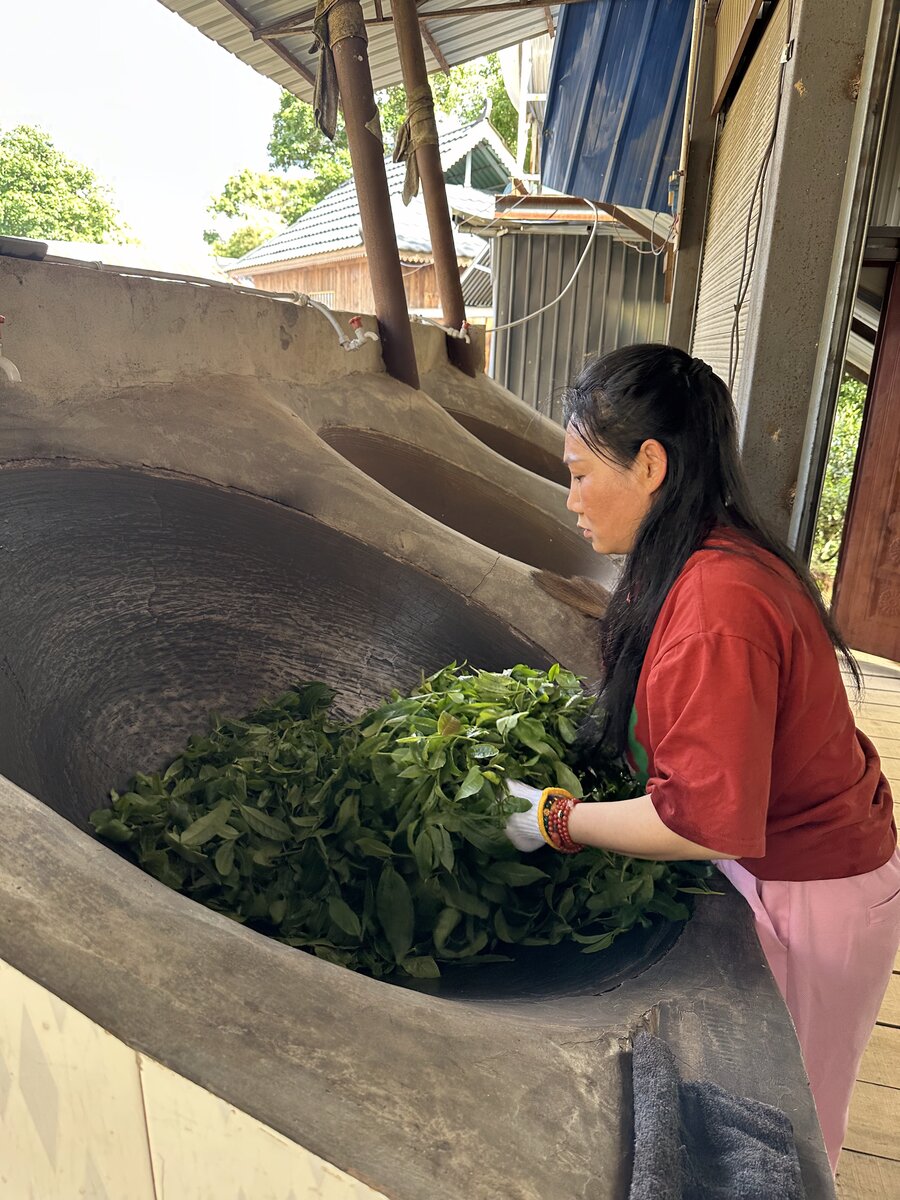
Puer tea kill-green, traditionally done by pan-firing, uses a wok temperature around 200°C (according to "Tea Processing Science"). Fresh leaves hit the wok, and the high heat rapidly destroys enzyme activity, halting oxidation.
But when is it time to remove the leaves from the wok? Not by a timer. It's by watching the leaf color shift from bright green to dark green, and smelling the grassy notes fade as a clean fragrance emerges. A few seconds' difference means a different taste.
In May this year, the 2026 World Humanoid Robot Games held its "Energy Transfer" launch event in Fuding, Fujian, where humanoid robots attempted the full white tea picking and processing workflow for the first time. The result: picking accuracy exceeded 90%, but during the charcoal roasting phase, robots could only assist — using thermal imaging sensors to monitor temperature, while the timing of roast-turning still required human technicians' judgment.
Rolling: 5 Minutes of Tactile Feel That Machines Can't Learn
Rolling is the key step that shapes tea leaves. Machine rolling takes 20-30 minutes, while hand rolling takes about 5 minutes (according to "Tea Processing Science"). But time isn't the point — tactile feel is.
Fingers feel the changes in leaf resistance: initially stiff, then gradually softening and forming strips as cells break and juices are released. When to press lightly, when to press firmly, when to stop — it all depends on the tea maker's hands.
Pile Fermentation: 50-55°C, Hands Inserted Into the Tea Pile
For Puer ripe tea pile fermentation, the optimal pile temperature is 50-55°C. Exceeding 65°C causes "burnt heart" and ruins the batch (according to "Tea Processing Science"). Tea makers don't constantly stare at thermometers — they insert their hands into the tea pile: slightly scalding but tolerable, roughly 55°C. At the same time, they smell the aroma changes: from sour notes to wine-fragrance to aged-fragrance, each stage indicating fermentation progress.
Machines Handle Standards, Humans Handle the Soul
In July this year, a Jianghan University AI team visited Chibi Zhaoliqiao to create a "digital archive" of green brick tea craftsmanship — converting old photos of pile fermentation, oxidation, and brick-pressing processes into dynamic imagery, preserving intangible cultural heritage in digital space. That same month, the second "When AI Meets Intangible Heritage" event launched at the 2026 World Artificial Intelligence Conference (WAIC), collecting 7,726 entries from teachers and students nationwide.
AI is indeed powerful in recording, disseminating, and standardizing. But recording is not replacing, and dissemination is not inheritance.
Machines handle standards — picking precision, transport efficiency, temperature monitoring. Humans handle the soul — kill-green timing, rolling pressure, pile fermentation judgment.
The kill-green scene we filmed at Hekai tea mountain, where the tea maker's hand stirs leaves in a 200°C wok — that image, machines cannot replace. Our tea processing knowledge base, from kill-green wok temperature to pile fermentation cycles — every parameter behind it represents human experience.
So, robot dogs are picking tea on the mountain. Does handcrafted tea still have a future?
Yes. Because machines solve the efficiency problem, while humans determine the quality ceiling.
FAQ
Will robot dogs replace human tea picking?
In standardized tea gardens, robot dogs can already handle picking and transport tasks, with single-bud picking accuracy of 90% and efficiency gains exceeding 300%. However, in premium tea regions, variables such as leaf shape, lighting, and weather far exceed the robustness of current vision and force-control systems. Skilled human pickers still achieve over 95% success rates. The current practical approach is a division of labor: machines pick standard-grade tea, humans pick premium-grade tea.
What is the difference between tea picking and tea processing?
Tea picking (harvesting) is removing fresh leaves from the tea plant — robot dogs can already do this. Tea processing is transforming fresh leaves into drinkable finished tea, including steps like kill-green, rolling, withering, fermentation, and pile fermentation. Each step relies heavily on the tea maker's experiential judgment and sensory feedback, making it difficult for machines to replace.
Which steps of handcrafted tea can machines not replace?
During kill-green, the maker watches leaf color and smells aroma to judge when to remove from the wok. During rolling, fingers feel changes in leaf resistance to judge when leaves have formed proper strips. During pile fermentation, hands are inserted into the tea pile to sense temperature while the nose monitors aroma changes. These real-time, multi-dimensional sensory judgments cannot currently be replicated by AI or robots. At the 2026 Fuding humanoid robot challenge, charcoal roasting timing still required human technicians.
Want to experience the authentic taste of handcrafted tea? Explore our product line
Browse Products →
Follow Songdehao on WeChat
Get more tea knowledge, tea processing insights, and new product notifications. We share firsthand stories from Yunnan's ancient tea mountains — from tea garden to teacup, showing you the craft behind every leaf.